
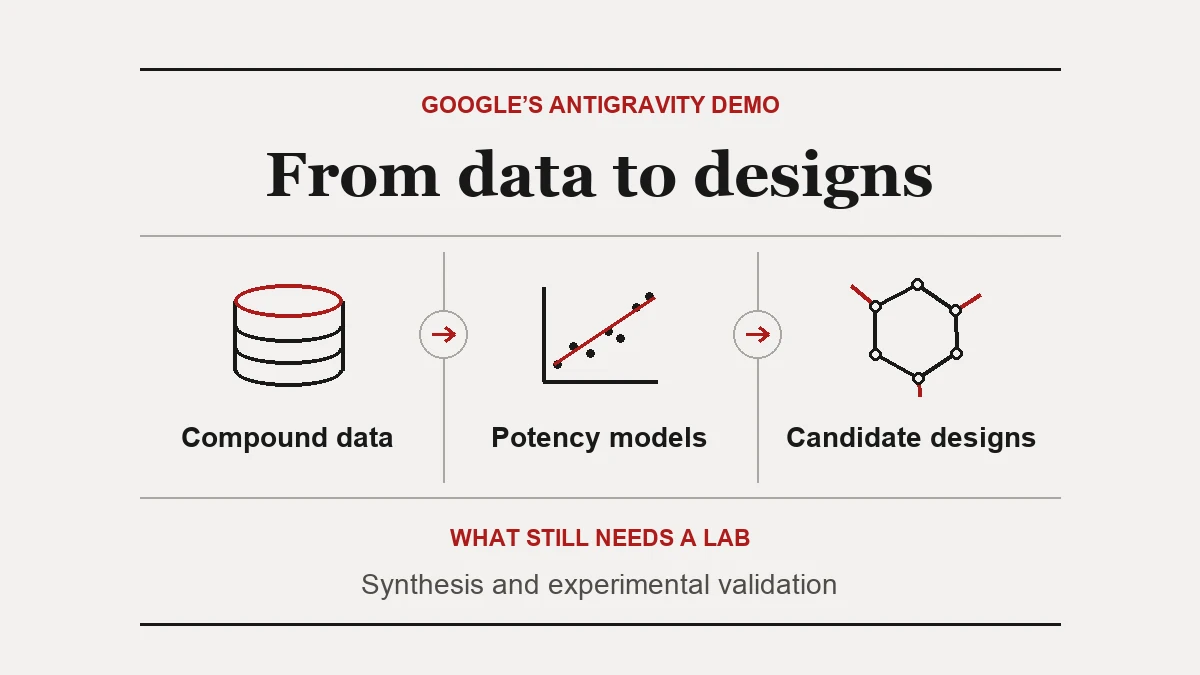
Google says its Antigravity agent searched thousands of compounds, compared their chemical structures, built potency models and proposed new molecules with synthesis routes in an hour. Potency describes the concentration needed to produce a specified biological effect; it does not establish clinical benefit. The useful result is a connected piece of computational research: assembling evidence and turning it into hypotheses a chemist can inspect.
In its 3 November demonstration, Google DeepMind applies its Cheminformatics Skills to a lung-cancer-drug example. Cheminformatics uses software to organize and analyze molecular structures and their associated data. The demonstration produces several concrete outputs, including a compound viewer and predictions evaluated on held-out data. Google also says every proposed design needs synthesis and experimental validation.
The agent connects databases, chemistry software and analysis
Google describes a division of labor: the language model handles orchestration, database navigation and reasoning, while deterministic chemistry tools perform molecular calculations. The system draws on RDKit, an established chemistry software toolkit, and connectors to ChEMBL and PubChem.
This matters because a plausible chemical explanation and a computed molecular property have different origins. An agent can decide which calculation to request and explain its output. The chemistry software performs the specified operation on the supplied structure.
RDKit’s documentation shows how it reads molecular representations and checks issues such as invalid valence. Those checks can catch malformed structures. A valid molecular graph still needs to match the molecule in the source, including relevant stereochemistry, and says little by itself about biological activity or ease of synthesis.
In Google’s example, the agent retrieves thousands of compounds, removes irrelevant entries such as buffers and solvents, and produces a report documenting sources. It then builds a viewer containing structures, associated data and plots. One plot compares cellular potency with the number of rotatable bonds, distinguishing macrocycles, molecules containing large rings.
These are useful review artifacts. A scientist can examine which compounds entered the analysis and investigate an apparent pattern. Their reliability depends on the underlying curation: whether structures were extracted correctly, duplicates reconciled and assay values kept in their proper context. An assay is a biological test that measures a particular response.
For example, converting two activity measurements into the same units does not make them biologically comparable. Different cell conditions or target mutations may change what an assay measures. The inspected announcement describes source reporting and filtering, but does not establish a run-specific audit of these details.
Molecular pairs help test the ring-closure idea
The demonstration explores rigidification: constraining a molecule’s flexibility, in this case by forming a ring. Google reports using matched molecular pair analysis, or MMPA, to compare cyclized and non-cyclized compounds, finding fewer rotatable bonds and generally greater potency.
The basic idea is to compare closely related molecules with a defined chemical change and examine the associated property difference. The mmpdb project, an independent implementation of matched-pair methods, explains how compounds can be broken into shared and changing parts to identify transformations. It supplies methodological context; the reviewed material does not establish that Google used mmpdb’s particular algorithm.
For the demonstration’s conclusion, the actual pairs matter. Readers would need the structures, transformation definitions, pair counts and comparable assay measurements to judge how strongly the results support cyclization. A scatterplot relating flexibility to potency cannot by itself isolate ring closure from other chemical differences.
Google uses the lung-cancer drugs crizotinib and lorlatinib to illustrate rigidification. Their history should not be read as a controlled experiment in which adding a bond explains every improvement. The original lorlatinib discovery paper’s abstract describes structure-based design, physical-property optimization, permeability and reduced drug efflux, meaning less pumping of the drug out of cells, alongside substantial synthetic challenges. Macrocyclization was part of that broader medicinal-chemistry effort.
Google reports held-out validation, including a scaffold split
Google says the agent builds multiple potency models using different features and architectures, then validates them on held-out data. A figure caption specifies a scaffold split across four experimental readouts.
That is a meaningful methodological detail. A scaffold split separates molecules according to their core structural frameworks. As the MoleculeNet methods discussion explains, it generally poses a harder generalization problem than randomly dividing compounds, which can leave closely related molecules on both sides.
The remaining question is how well the models performed and how the evaluation was organized. The readable announcement text inspected for this article did not provide verified numeric errors, assay-specific sample counts, baseline scores or a full model-selection procedure. We therefore cannot quantify predictive accuracy from that text.
An inspectable evaluation would show the fixed data partitions, duplicate handling, how models were selected and the errors for each readout. Those details help establish whether the held-out set remained an independent test during development. They are review questions, not evidence that leakage occurred.
Even a strong held-out result would need careful interpretation for newly proposed macrocycles. Predictions become less dependable when a design differs substantially from the molecules on which a model was trained. Google itself identifies sparse data, inter-laboratory assay noise and narrow measurement ranges as limits on precision.
Public connectors do not identify the complete demonstrated run
Google links a public science-skills repository. In the snapshot inspected on 7 November, identified as 4de6786171f1479026da5d3a00f110703c8ba35e, the skills listing included ChEMBL and PubChem connectors.
The ChEMBL connector instructions at that snapshot document activity retrieval, unit normalization and access to assay, document and structure information. The PubChem instructions cover identifiers, properties, structure searches and assays.
These provide inspectable components. The reviewed listing had no dedicated cheminformatics, RDKit, MMPA or molecular-machine-learning directory, and the inspected materials did not identify a complete executable archive of this demonstration with its input data, prompts, logs and outputs. That finding applies to the reviewed public snapshot; it does not describe every private plugin component or future release.
Reproducing the reported hour would also require timing boundaries. The announcement describes several user requests, including requests for models and final designs. It does not establish a single-prompt autonomous run or disclose a controlled timing protocol covering setup, caching, human corrections, repeat runs and an expert baseline.
The hour is Google’s reported duration. No independent timed reproduction was verified for this article, and search-access limits prevent a broader conclusion about what independent work exists.
Proposed molecules and routes still need physical tests
The workflow ends with generated molecular designs, predicted potency, medicinal-chemistry explanations and proposed synthetic routes. A route consistent with documented reactions gives a chemist something concrete to assess. Its feasibility still depends on whether those reactions work on the particular molecules, with usable yields and products.
This is a different stage from the physical laboratory loop in AutoDNA’s demonstrations, where plans connect to instruments and experimental measurements.
For Antigravity’s proposed compounds, the next decisive evidence would be route review, successful synthesis and measured activity. Google explicitly calls for synthesis and experimental validation of every design. Predicted potency and brain penetration can help prioritize that work; establishing either requires physical measurements.